Finding sunlight
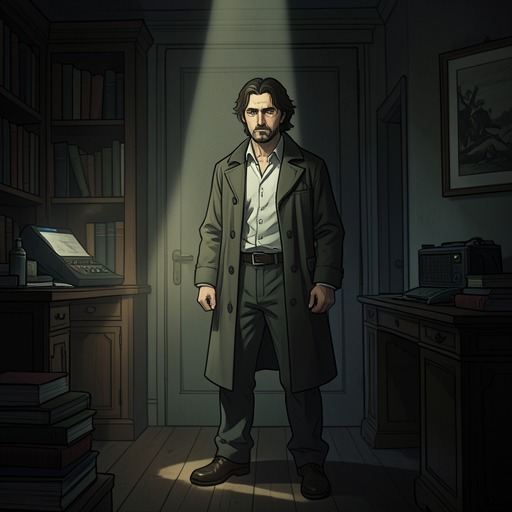
Chasing Sunlight“Finding sunlight” names the central quest of Jonathan Heights, whose insistence that he has seen the sun drives the expedition aboard the Endeavor into territories that human society treats as both savage and forbidden. The phrase begins as a seemingly impossible personal claim, but it gradually becomes a governing command: Jonathan is willing to defy the Society of Explorers, abandon inherited knowledge, cross the eastern limit of human civilization, and risk the safety of his companions rather than allow the search to be stopped.
A Myth That Organizes the Expedition
In a world of lightless skies and endless secrets, humanity defines itself as a vigil of light against eternal darkness. The Illuminated King and the Reflected Council represent the political and institutional order that claims authority over that light, while the eastern lands beyond human control are described through fear, secrecy, and the language of savagery. Against this setting, Jonathan’s claim to have seen sunlight is dismissed as a laughable myth and fairy tale. He nevertheless assembles an expedition to the far east, where wonders and horrors lie between the human settlements and his destination, and boards the Endeavor with agents of both the crown and the underworld around him.
The search is therefore more than an exploration route. It challenges the accepted boundary between what humanity knows and what it is permitted to know. At Danby’s Point, the illuminated track reaches the easternmost terminus of human civilization beneath a tall, zint-illuminated tower built into bruised-purple rock. Human blue-white light spreads across one side of the plateau, while the illumination and architecture of other races press against it. The Inquisition is simultaneously strongest and weakest there: it attempts to contain contact, yet must bow to the inevitability of trade. The physical frontier makes the political meaning of the quest visible, because finding sunlight requires Jonathan to pass beyond the place where human authority can pretend to define the world.
Knowledge, Maps, and the Eastern Threshold
Jonathan’s pursuit depends on knowledge gathered through unstable alliances rather than on faith alone. At Danby’s Point, he consults Tiuni, whose information about the eastern powers, beasts, shifting caravans, the Verdant Expanse, and ancient ruins allows him to narrow the expedition’s possible routes. Her intelligence is indispensable even though Jonathan knows she is not human and ultimately not on his side. The exchange turns the search for sunlight into a negotiation over who may possess, translate, and control knowledge of the east.
Tiuni’s warning changes the status of the phrase. When Antomine identifies one of her statements as a lie, Tiuni explains that a man returned from the farthest east and that such a return should not happen again, because the secrets there ought not to be disturbed. Jonathan immediately demands to know what she knows about sunlight. Tiuni treats it as a myth, but connects it to ancient things that Jonathan might lead back into human lands. The reply does not disprove the quest; instead, it suggests that the supposed light is entangled with older powers and with consequences that may reach back toward civilization.
The boundary itself deepens that uncertainty. A great metal gate under intense zint light separates the human portion of the plateau from territory claimed by darker forces, yet the influence runs in both directions: distant spires are twisted and hunched, while those near the wall have been pulled into straighter lines. The nonhuman inhabitants make the distinction between human and alien still less secure. The Fractured resemble humans whose forms have been viewed through dark water, their faces and limbs changing from moment to moment, while the Tarfolk appear as spindly, many-limbed masses of black tar with unsettlingly human eyes. Finding sunlight thus proceeds through a world in which the categories of human, nonhuman, civilized, and savage are visibly unstable.
Obsession as Method and Transformation
Jonathan’s commitment changes the way he conducts the expedition. He spends the journey educating his companions in the rules required to avoid disaster, intending to take command in emergencies and foreign encounters. His attention is directed toward the destination rather than toward ordinary sociability or institutional caution. When Antomine argues that an Umbraught nest in Angkor Leng must be purged because the creatures now know that zint exists and might carry the danger westward, Jonathan refuses to divert the Endeavor. He insists that the party is not a navy and lacks the time and resources to survey and cleanse a city the size of Angkor Leng. The Inquisition’s broader conception of civilization conflicts with his single-minded measure of relevance: anything that does not advance the journey to sunlight is a distraction.
That obsession also alters his character. Eleanor observes that Jonathan was once more personable, almost charming. He answers that he understands more now, and that charm did not save his last expedition; being personable does little to bring the current expedition to its destination. His present severity is deliberate, a protective instrument shaped by failure and directed toward the light. Antomine warns him not to lose himself entirely, identifying obsession as a danger that must be checked. Jonathan replies that obsession is the reason both Eleanor and Antomine are aboard. The search therefore binds the expedition together even as it erodes the qualities that might make companionship possible.
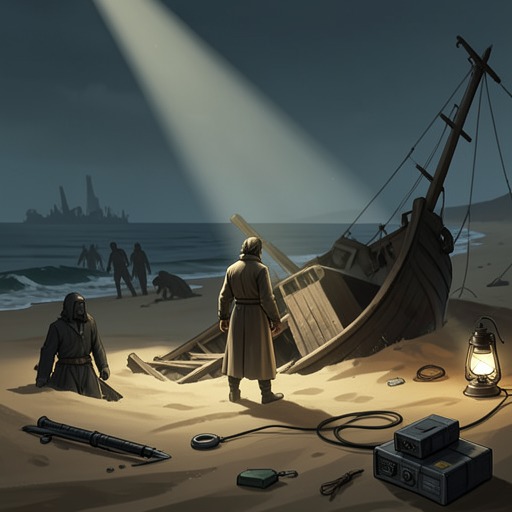
The clearest practical sign of the change comes when Jonathan constructs an alien compass from a mechanism of interlocking rings. He copies the geometries of earlier explorers, wrapping wire around the device and fitting each completed ring into a sliding armature whose relationships defy ordinary human comprehension. The work demands exact angles and distances that his hands previously managed only through long rests and brute effort. Now sunlight burns inside him and drives both his fingers and his mind. The quest has ceased to be merely an idea directing his actions; it has become a force that materially increases his capacity to pursue it.
Renunciation of the Past
The search reaches a decisive ideological turn at Terminus. After the Endeavor prepares to depart and the lights of the settlement recede, Jonathan takes the books he purchased there—volumes containing secrets and knowledge he has wondered about throughout his life—and carries them onto the top deck. One by one, he throws them into the darkness below. The gesture rejects the accumulated past as an authority over the future. The books belong to the past, not to what lies ahead; Jonathan is prepared to burn everything he possesses in order to see sunlight again.
This renunciation gives the expression its strongest contrast. Jonathan’s expedition is built from maps, inherited mechanisms, trade intelligence, and the accumulated work of earlier explorers, yet he ultimately treats that inheritance as something that must be discarded if it blocks discovery. The search requires knowledge, but not reverence for knowledge; it uses civilization’s instruments while refusing civilization’s limits. That paradox makes “Finding sunlight” both an exploratory objective and a test of whether any human order can survive contact with the truth it claims to seek.
Political and Thematic Significance
The phrase exposes a conflict between personal revelation and public doctrine. The institutions of Beacon, the Illuminated King, the Reflected Council, and the Inquisition treat light as the basis of civilization and darkness as the domain of danger, but they also regulate the movement of people, materials, and information across the frontier. Jonathan’s search appears to pursue the same civilizational ideal while violating its methods of containment. He accepts the language of light but refuses to let official guardians decide where the light may be found.
At the same time, the evidence keeps sunlight suspended between miracle and threat. Jonathan speaks with absolute certainty, while others call the object of his pursuit a myth. Tiuni fears not the light itself so much as the ancient things Jonathan may bring back from the farthest east. Antomine sees the expedition through the duties of civilization and containment, whereas Jonathan sees only the necessity of reaching the destination. The quest consequently preserves a productive uncertainty: sunlight may be revelation, danger, or both, but its decisive narrative power lies in what the belief in it makes Jonathan willing to abandon.
“Finding sunlight” finally describes a movement from inherited darkness toward an unknown truth, but not a simple movement from ignorance to enlightenment. Jonathan’s pursuit creates new knowledge even as it destroys old loyalties, crosses political borders, unsettles human categories, and turns obsession into a source of strength. The phrase is the expedition’s promise and its threat: the light he seeks may illuminate the world, yet the search itself has already begun to consume the man who insists on reaching it.